
I had always heard that studying music makes kids smarter and is good for the brain. I started music lessons at an early age, and eventually music became my entire life, so that idea just became one of those random facts I had heard so many times that I never really gave it much thought.
It wasn't until college, when I took a class in music cognition, that I started to understand what was actually happening. What interested me wasn't simply the claim that music somehow makes someone “smarter.” It was learning that the process of studying music can actually produce measurable changes in the brain.
Researchers aren't just giving musicians and non-musicians tests and comparing the scores. They have used MRI, functional brain imaging, diffusion imaging, MEG, EEG, and other techniques to look directly at the structure and activity of the brain. Some studies compare experienced musicians with non-musicians, while others follow children over time to see what happens after they begin musical training.
What I'm writing here is an abbreviated—and considerably less academic—version of one of the papers I wrote for that music cognition class. I'm not particularly interested in trying to prove that every kid who takes piano lessons is suddenly going to become a genius. The actual neuroscience is much more interesting than that.
The question I want to look at is pretty simple:
What actually happens to the brain when someone consistently studies music?
Playing an Instrument Is a Ridiculously Complicated Task
Playing music doesn't feel particularly complicated once you've been doing it for years. A musician looks at a page of music and plays it. Eventually a lot of that process becomes almost automatic.
But think about what the brain is actually doing.
If I'm reading music while playing an instrument, my eyes are recognizing a collection of symbols. My brain has to translate those symbols into pitches, rhythms, articulations, dynamics, and timing. Those instructions then have to become extremely precise physical movements.
At the same time, I'm listening to the sound I just produced.
My brain compares what I'm hearing with what I expected to hear. If the pitch, timing, articulation, balance, or tone isn't right, I make a physical adjustment—sometimes almost instantly.
If I'm playing with an ensemble, I'm doing even more. I'm maintaining my own part while listening to everyone else, matching their time and articulation, responding to changes in tempo and dynamics, watching a conductor or communicating visually with other musicians, and anticipating what's about to happen.
There isn't one little “music center” in the brain doing all of this.
Musical performance brings together auditory, motor, visual, sensory, attentional, and memory systems. Researchers comparing musicians and non-musicians have found structural differences in regions involved in precisely these kinds of functions (Gaser and Schlaug).
Practice Doesn't Just Change What You Know
We usually think about practicing as putting information into the brain.
Practice a scale enough times and you remember it. Practice a piece enough times and eventually you can play it.
That certainly happens, but neurologically, practice is doing considerably more.
The brain is plastic. It changes in response to the things we repeatedly ask it to do.
Musicians are especially interesting to neuroscientists because instrumental practice combines extremely precise movement with hearing, timing, visual information, memory, and constant feedback. A musician may repeat a physical movement thousands of times while simultaneously listening to and evaluating the result.
Researchers have found differences between musicians and non-musicians in gray matter, auditory regions, motor-related areas, and the pathways connecting different parts of the brain (Gaser and Schlaug; Pantev et al.).
But simple musician-versus-non-musician comparisons leave an obvious question:
Did music cause those differences, or were those people already different before they became musicians?
That's where studies following children over time become particularly interesting.
Researchers Actually Watched Children's Brains Change
In 2009, Krista Hyde and her colleagues followed young children receiving instrumental instruction and compared them with children who were not receiving the same musical training.
Before training, the researchers did not find significant differences between the groups in the relevant brain and behavioral measurements.
After only 15 months of instrumental training, measurable structural changes had appeared in the music students. The changes included areas associated with auditory processing and motor control, and those changes were related to improvements in the children's motor and auditory-musical abilities (Hyde et al.).
That is one of the findings I find particularly fascinating.
These weren't professional musicians who had been practicing for thirty years. They were children, and researchers could measure differences after a little more than a year of training.
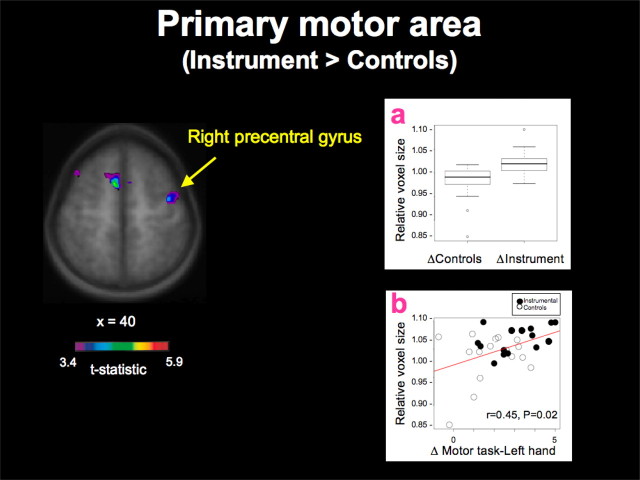
The right precentral gyrus result, with the group comparison and its relationship to improvement on the left-hand motor task.
View original Figure 1 ↗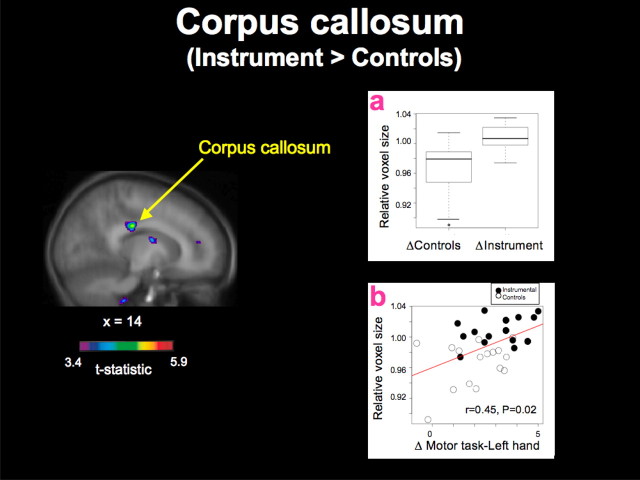
The corpus-callosum result, with the group comparison and its relationship to improvement on the left-hand motor task.
View original Figure 2 ↗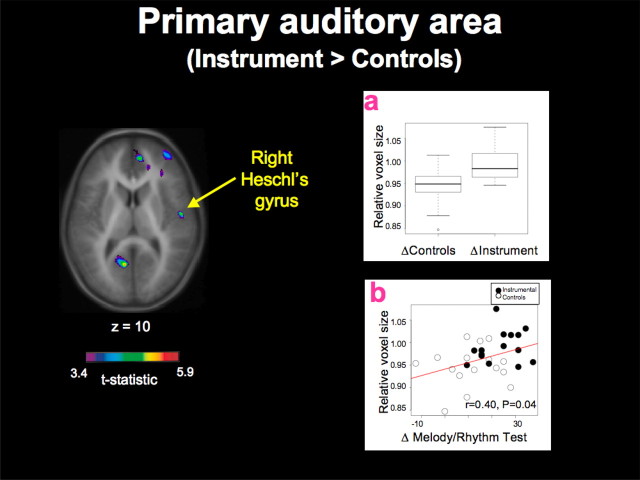
The right Heschl’s gyrus result, with the group comparison and its relationship to improvement on the melody-and-rhythm test.
View original Figure 3 ↗A later longitudinal study by Assal Habibi and colleagues followed children beginning around age six. The researchers found no significant structural brain differences between the groups at the beginning of the study.
After two years, however, the children involved in music training showed differences in cortical development and changes involving the corpus callosum, including white-matter pathways connecting frontal, sensory, and motor regions (Habibi et al.).
So when people say learning music “changes the brain,” that isn't entirely figurative language.
Researchers have literally measured structural changes developing over time.
Building Connections in the Brain
Another thing I remember finding fascinating was that music doesn't only affect individual areas of the brain. Musical training is also associated with differences in how different areas communicate with one another.
Some of that communication happens through the brain's white matter.
Gray matter contains large concentrations of neuron cell bodies. White matter consists largely of axons—the long fibers neurons use to communicate with other areas of the nervous system. Many of those fibers are insulated by myelin, which helps neural signals travel efficiently and reliably.
So, in very broad terms, white matter is part of the brain's communication infrastructure.
A diffusion-imaging study by Sara Bengtsson and her colleagues examined professional pianists and found relationships between the amount of practicing they had done and the organization of specific white-matter pathways. Childhood practice showed especially extensive relationships, including pathways involved in movement (Bengtsson et al.).
This doesn't mean every hour of piano practice literally installs another wire in your head. The biology is considerably more complicated than that.
But it does mean that extensive practice is associated with measurable differences in the physical organization of the pathways the nervous system uses to communicate.
Connecting the Two Sides of the Brain
One structure that comes up repeatedly in research on musicians is the corpus callosum.
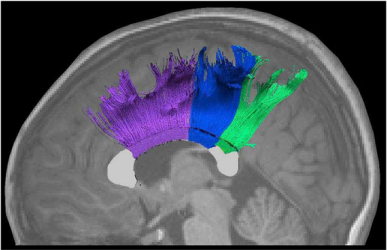
The corpus callosum is the enormous bundle of nerve fibers connecting the left and right cerebral hemispheres.
Musicians give that system quite a workout.
A pianist may be performing completely different movements with the two hands simultaneously. A drummer may be coordinating four limbs independently. A string player uses one hand to determine pitch while the other controls the bow. At the same time, all of those movements are being coordinated with what the musician hears.
A classic study by Gottfried Schlaug and colleagues found that the anterior portion of the corpus callosum was larger in musicians than in non-musicians. The difference was especially pronounced among musicians who had begun training before age seven (Schlaug et al.).
By itself, that study doesn't prove lessons caused the difference.
But when findings like that are considered alongside longitudinal studies in children—where differences emerge after training begins—the evidence for experience-dependent changes becomes considerably stronger (Habibi et al.).
Musicians Don't Just Hear Music Differently
The auditory system gives us another interesting example.
Everyone with normal hearing uses the auditory system when listening to music. A non-musician's brain doesn't suddenly shut off when a song starts.
But years spent paying very close attention to pitch, rhythm, tone, harmony, articulation, and timing appear to be associated with differences in how the auditory system processes sound.
In one study, professional musicians showed a substantially stronger early auditory-cortex response to tones than non-musicians and also showed greater gray-matter volume in part of Heschl's gyrus, which contains primary auditory cortex (Schneider et al.).
The researchers also found that these differences were related to musical aptitude, so this particular result shouldn't be interpreted as proof that lessons alone caused everything they observed.
Still, the general idea makes intuitive sense.
A musician doesn't simply hear a trumpet note.
We might hear whether it is sharp or flat, whether it began exactly with another instrument, whether its articulation matches the section, where it sits inside a chord, whether the balance is correct, what kind of tone is being produced, and where the harmony is going next.
Do that for thousands of hours and the auditory system becomes incredibly practiced at extracting information from sound.
Sometimes the Difference Appears Even When the Musician Isn't Playing
This may be one of the coolest examples.
In 2015, Iballa Burunat and colleagues scanned musicians and non-musicians while they simply listened to music.
The musicians showed significantly greater functional symmetry between corresponding areas of the two hemispheres, particularly throughout visual and motor-related networks. At the researchers' chosen statistical threshold, non-musicians did not show areas with greater symmetry than musicians (Burunat et al.).
That does not mean a non-musician's brain was inactive.
It means that the particular pattern of coordinated activity the researchers were measuring was dramatically different between the two groups.
And the musicians weren't even performing.
They were listening.
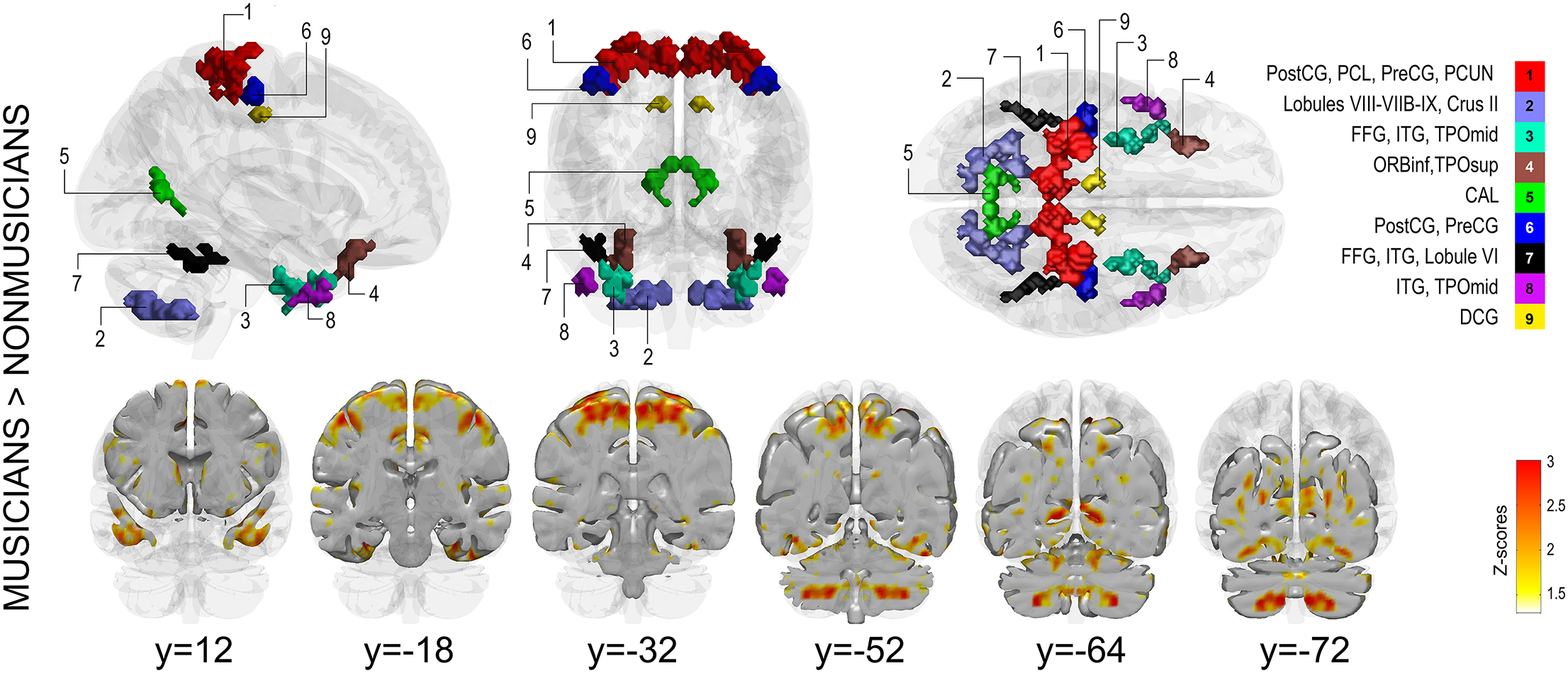
As a musician, that result feels strangely familiar.
When I listen to music, I don't think I can hear it in quite the same way I did before becoming a musician. I hear the bass line, the harmony, the orchestration, the rhythmic structure, and where things are probably going next. Sometimes I can almost imagine the physical movement involved in playing what I'm hearing.
The interesting part is that some of those differences aren't merely subjective. Researchers can measure differences in how trained musicians' brains respond while listening.
The Effects Don't Necessarily Stay in Music
Another interesting question is whether all of this training simply makes someone better at playing music.
Apparently, not necessarily.
Music and language have quite a bit in common from the brain's perspective. Both require us to make sense of rapidly changing patterns of sound. Small differences in pitch, timing, rhythm, and emphasis can carry important information in speech.
Musicians spend years becoming extremely sensitive to those same kinds of acoustic details.
Research has associated musical training with differences in speech and language processing, including the neural processing of speech in noisy environments (Strait et al.). Longitudinal research has also found changes in the neural processing of speech following continued musical training (Tierney et al.).
Musical training has also been associated with differences or improvements in working memory, attention, executive function, inhibitory control, and auditory memory. These are particularly interesting because they aren't exclusively musical skills. They are general cognitive processes being exercised through musical activity (Miendlarzewska and Trost).
Think about what a student is actually doing while reading and performing music.
They have to maintain attention, hold information in working memory, anticipate what is coming next, ignore distractions, recognize mistakes, stop incorrect movements, and make corrections while continuing to perform.
Those aren't exclusively musical processes.
They're general cognitive processes being exercised through music.
There is still debate about how large these effects are and how broadly they transfer, but there is evidence that the effects associated with musical training aren't confined entirely to someone's ability to play an instrument.
And I think that's a much more interesting way to describe the old idea that “music is good for your brain.”
So Does Music Make Kids Smarter?
That's the phrase everybody has heard.
“Music makes kids smarter.”
I think it's probably an oversimplification of something much more interesting.
The strongest story isn't that playing Mozart magically increases intelligence.
It's that sustained music study repeatedly asks a developing brain to coordinate an extraordinary number of systems at the same time, and researchers have observed measurable changes associated with that training.
We have longitudinal studies showing structural changes after children begin instrumental instruction.
We have research showing differences in auditory and motor systems.
We have evidence involving white-matter organization and the corpus callosum.
We have studies showing differences in the neural processing of speech and other non-musical cognitive processes.
And we have functional brain imaging showing that experienced musicians can process music differently even when they're simply sitting still and listening.
That's plenty remarkable without turning music education into some kind of miracle cure.
The Brain Gets Good at What We Ask It to Do
Ultimately, that's probably the simplest way I can describe what I learned studying music cognition.
The brain adapts to what we repeatedly ask it to do.
Music just happens to ask it to do an extraordinary number of things at once.
A student learning an instrument isn't simply memorizing where the notes are. They're repeatedly coordinating hearing, vision, movement, timing, memory, attention, prediction, and sensory feedback.
At first, every part of that process is difficult.
Then something interesting happens.
The rhythm that once required intense concentration becomes automatic. Fingers begin finding notes without conscious thought. Students begin hearing mistakes before anyone points them out. They anticipate what comes next. Eventually they're capable of listening to themselves while simultaneously listening to an entire ensemble.
We normally call that getting better at music.
Neuroscience gives us another way of looking at it.
The student's brain has been adapting to the task.
And that's what I find so fascinating about music education. Studying an instrument isn't simply putting musical information into a child's brain. Every practice session asks that developing brain to perform an unusually complicated combination of tasks, over and over again.
Over time, the brain responds.
Works Cited
- Bengtsson, Sara L., et al. “Extensive Piano Practicing Has Regionally Specific Effects on White Matter Development.” Nature Neuroscience, vol. 8, no. 9, 2005, pp. 1148–1150.Read the study ↗
- Burunat, Iballa, et al. “Action in Perception: Prominent Visuo-Motor Functional Symmetry in Musicians during Music Listening.” PLOS ONE, vol. 10, no. 9, 2015, e0138238.Read the study ↗
- Gaser, Christian, and Gottfried Schlaug. “Brain Structures Differ between Musicians and Non-Musicians.” The Journal of Neuroscience, vol. 23, no. 27, 2003, pp. 9240–9245.Read the study ↗
- Habibi, Assal, et al. “Childhood Music Training Induces Change in Micro and Macroscopic Brain Structure: Results from a Longitudinal Study.” Cerebral Cortex, vol. 28, no. 12, 2018, pp. 4336–4347.Read the study ↗
- Hyde, Krista L., et al. “Musical Training Shapes Structural Brain Development.” The Journal of Neuroscience, vol. 29, no. 10, 2009, pp. 3019–3025.Read the study ↗
- Miendlarzewska, Ewa A., and Wiebke J. Trost. “How Musical Training Affects Cognitive Development: Rhythm, Reward and Other Modulating Variables.” Frontiers in Neuroscience, vol. 7, 2014, article 279.Read the study ↗
- Pantev, Christo, et al. “Increased Auditory Cortical Representation in Musicians.” Nature, vol. 392, no. 6678, 1998, pp. 811–814.Read the study ↗
- Schlaug, Gottfried, et al. “Increased Corpus Callosum Size in Musicians.” Neuropsychologia, vol. 33, no. 8, 1995, pp. 1047–1055.Read the study ↗
- Schneider, Peter, et al. “Morphology of Heschl's Gyrus Reflects Enhanced Activation in the Auditory Cortex of Musicians.” Nature Neuroscience, vol. 5, no. 7, 2002, pp. 688–694.Read the study ↗
- Strait, Dana L., et al. “Biological Impact of Preschool Music Classes on Processing Speech in Noise.” Developmental Cognitive Neuroscience, vol. 6, 2013, pp. 51–60.Read the study ↗
- Tierney, Adam T., Jennifer Krizman, and Nina Kraus. “Music Training Alters the Course of Adolescent Auditory Development.” Proceedings of the National Academy of Sciences, vol. 112, no. 32, 2015, pp. 10062–10067.Read the study ↗